Showing posts with label Impetus. Show all posts

Thursday, 1 December 2011

Imperial Ambitions

I have three weeks over Christmas and plan to spend a lot of the time painted a 28mm Early Imperial Roman Army for the Impetus Tournament circuit next year - that is when I can escape family commitments. For inspiration I have just finished reading Anthony Everitt's biography of Augustus and I'm moving onto Frank McLynn's bio of Marcus Aurelius.

I decided on the army following a few games of Hail Caesar (HC). I didn't want to replicate the Marian Roman army I have in 15mm in another scale, and the rules for line relief in Republican Roman armies in Impetus put me off that option. Thankfully these rules have been improved in Extra Impetus 4 but I have already invested in Imperial Recruits.


You will have noticed that I plan to use the army in two different rule sets. While Impetus will remain my primary ancient ruleset I have enjoyed the alternative of HC and hope to find time for both. The problem this brings is basing. HC, and other rulesets, require some individual basing of figures where Impetus relies on unit bases. I have therefore went with basing units for HC and creating unit stands to place them on for Impetus.


The army composition is still to be finalised. I am split between taking more infantry or more cavalry. There is a requirement to have at least four units of Legionaries/Auxiliaries and I also want at least two units of medium cavalry and one light. The decision is between an additional two units of Legionaries/Auxiliaries or an additional two cavalry units.

In the long run I plan to paint up enough figures to deploy either army but I need to make a decision for preparing the army for the York tournament on 5th February. At present I think I will stick with the tradition of the Roman army at the time being an infantry army and go with the extra Legionaries/Auxiliaries.

For the Legionaries/Auxiliaries I am splitting the units 50:50 between heavy (FP) Legionaries and light (FL) Auxiliaries. This split gives the option of deploying in two battle lines and allowing as FP and FL can interpenetrate.


All of the figures are Warlord Games. I have found their plastics a lot easier to assemble than Wargames Factory but their metal miniatures tend to need a lot of tidying up. The models to look great with the main frustration being that the Legionnaires are clearly smaller than the Auxiliaries.


So far I have painted one unit of Legionaries and one of Auxiliaries. For the Legionaries I am basing six figures on a 6cm x 4cm base. Two bases together will form on Impetus unit and three a unit for HC. Having three bases for HC will allow the unit to change between column, line and wedge formations easily. The Auxiliaries are based individually with seven  being magnetised to a 12cm x 6cm base for Impetus. The single basing allows them to be deployed either formed or in various degrees of skirmish for HC.


Thursday, 10 March 2011

Preparing for Towton

After all the effort in January to get my Normans ready February was a bit slow but it's time to get back into gear as I have two projects to finish by mid-April. Trev is organising a Lasalle battles day on the 23rd April so I need to complete my French army by then and hopefully get some practice games in. The army needs the artillery finished off and a brigade of Dragoons but more about that in another post.

Before that JP and I are putting on a demonstration game of the battle of Towton at a festival on 17th April. I need to complete a Lancastrian army of 400pts in 15mm and the rest of this post will outline that army.

The army is divided into three battles, the Duke of Somerset's, the Duke of Exeter's, and the Earl of Northumberland's. Each battle consists of two units of archers with two large units, one of men-at-arms supported by billmen, and one solely of billmen. In addition to this there is a large unit of Scottish pikemen and unit of light cavalry.

All told, 21 stands holding 190 figures. The figures are all Peter Pig and they are excellent figures. I have the last of them on order and hope to pick them up this weekend.


I managed to make a start on the Duke of Somerset's battle completing the archers, men-at-arms and one stand of billmen. I always find it initially difficult when I move between painting scales. Going from 28mm to 15mm I have to stop myself doing unnecessary detail and additional shades.

While historically each battle was made up of the retinues of a number of nobles, for the demonstration I want the three different battles to be clearly distinguishable so all retinue soldiers will have the livery of the commander, for the Duke of Somerset its white and blue.


Anyway another busy month of painting ahead during which we need to find time to write up the scenario and short history as a handout for the demo.

Wednesday, 16 February 2011

Historical Battles Day

Last weekend I was at Didcot near Oxford for a historical battles day using Impetus. A big thanks goes to Bevan for arranging everything, and to all the lads who took part and made it such an enjoyable day.

Bevan came up with a system where we all drew a slip at the beginning of the day that told us the order of the battles we would fight and which side we were. I'm still not 100% sure how it worked out but it ensured that we all faced three different opponents.

My first game was a refight of Hastings commanding the Saxons against Simon commanding the Normans. Saxons deployed first across the top of the hill. The Huscarls were in the centre with the Select Fyrd long spear protecting the flanks and a couple of skirmish units out front. The Normans deployed some Knights to their left and some in the centre with half the infantry between and half on the right.

The Normans advanced the infantry first to try to disrupt the Saxon Shieldwall with archer fire. The Saxon skirmishers moved to counter and were able to win the missile duel. In Impetus skirmishers are more effective than low quality (VBU 3 or less) missile troops as the minus two for firing at skirmishers cancels out the higher VBU.

The Norman Knights then charged forward but the Saxon Shieldwall continued to hold. The impetuous nature of the knights means that even when they lose a combat there is little a general can do as they become disordered in front of the enemy and therefore continue to charge in unit their are expended. With the Norman knights expended and the Saxons began to move down of the hill to chase of the remaining Norman infantry.

Historically, the Normans won at Hastings when part of the Saxon line pursued some fleeing Bretons down the hill opening up the Shieldwall. In Impetus, only a small number of units are forced to pursue, Saxons not included, so this tactic cannot be used. Other refights on the day did see the Saxons break, key to which was the loss of Harold.

The next game was Cannae and took the role of Hannibal versus Edward in command of the Romans. In order to represent the battle two of the four Roman Legions were raw Legions and all of the Carthaginian forces were up graded. The Romans had to deploy first, and chose to place the two raw Legions on their left, the standard Legions on the right with Triarii placed on either side of the line to protect the flanks.

Even with the upgrades the Carthaginian troops, luck aside, would not stand up to a head-on fight with the Legions and therefore needed to get around the flanks. All the cavalry was deployed on the right opposite the raw Legions along with a unit of veteran spearmen. Two units of Gauls were deployed on the left flank with Spanish light infantry and skirmishers across the centre.

The Romans held their position while the Carthaginians advanced. The Carthaginian centre halted just within missile range and engaged the Roman Velites while the Carthaginians pressed both flanks. Despite stubborn resistance the Roman flanks began to give way with the raw Legions pinned without room to maneuver. With both flanks turned the Roman Legions on their right launched a final charge forward but were held by the Spanish light infantry. The Numidian cavalry had now got around the back of the Legions and the encirclement was complete.

This is the first time I have used an army that has been upgraded across the board and it did mean that the Romans were outclassed in almost all areas of the field giving a historic feel to the battle. The standard problem with the Republican Roman army was noted in all the battles fought during the day. That exchanging lines is too difficult so the Romans have difficulty utilising their extra numbers. 

The final battle of the day was Towton, John commanding the Lancastrians while I commanded the Yorkist. True to history the scenario had the wind blowing in the Lancastrians faces giving the Yorkist a range advantage for their archers. The armies deployed with the three battles side-by-side in a line.

Initially both armies advanced to get within effective archery range. The Yorkist pushed forward on their left resulting in the Lancastrian right checking its advance to prevent it being outflanked. The arrival of the Duke of Norfolk's small force on the Yorkist right prevented the Lancastrians from advancing on the other flank also.

This left the Lancastrian centre ahead of the rest of the line allowing the Yorkist to concentrate their fire on it which, along with the additional range from the weather, resulted in the Yorkist winning the archery duel. A final charge by Lord Fauconberg on the Yorkist left but the Lancastrian battle opposite to flight followed by the rest of the army.

This was the first time I have used a medieval army and the potency of the longbow was evident. As the next thing on my painting table will be a Wars of the Roses army this was a useful opportunity to consider how it can be effectively used. The key challenge will be getting the enemy to advance against the archers.

This was a great day and a great format. One that I hope we can use again.

Friday, 11 February 2011

Storming Normans

Having managed to paint my Normans they were put to the test at the York Impetus Tournament last weekend. I had planned to do a more in-depth post cataloguing the three battles from the tournament in detail but as a week has nearly past and I have yet to find the time I thought a shorter post outlining the lesson learnt would by more achievable. I also apologise for the lack of photos but in the excitement I forgot to take any.

Having seven units of cavalry against two to four I was the attacker in every game. This meant that my opponents got to place the initial terrain. As expected they tried to cover the flanks as much as possible with woods which meant that my single choice to move/remove one item of terrain was always to open up one flank.

In the first game this played into my opponents hand. Steve fielded a Romano-British Army whose strength lay in four large units of long spears. Using his Genius level General he was able to deploy them after my Knights and take up position opposite. Successfully covering his flank I was drawn on to his spears where my Knights were easily taken down. Luckily, his attempt to counter attack with his cavalry was stopped by my missile troops in the centre allowing me to hold out for a draw. A key lesson here was the need to mix up my infantry and cavalry more when uncertain about the enemies deployment in order to prevent a complete mismatch. The impetuous nature of the Knights means they cannot be moved easily to a different part of the field once the battle commences.

The next game was against Phil's Carthaginians. Have used Carthaginians a lot in the recent ancients campaign so I know the army well. The key to defeating them is to target the Punic infantry and cavalry as their mercenary troops do not count significantly towards their break point. The Carthaginian deployment left enough room for my light horse and a unit of Knights to get around the flank of the Punic Spearmen. The dice then fell favourably for me in two successive charges which saw half the Carthaginian army destroyed and the rest in flight. Key lesson from this battle was that impetuous troops are required to either move wheel towards the enemy or more straight forward in their first move. By starting the Knights at an angle towards the side of the board the can quickly get round the enemy flank.

The third battle was against Kelly's Early Germans. We had fought each other the previous Thursday as a warm up for the tournament so were familiar with each others armies. Kelly's army has two commands, one infantry and one cavalry, so I knew that routing the infantry command would break the whole army. Leaving my bulk of my infantry to hold off his cavalry I sent the Knights against the Warband on the flank. Using the same manoeuvre as the second battle I was able to threaten their flank. In order to counteract this the central Warband turn to assist the flank but in doing so exposed its flank to the central Norman force consisting of spearmen and light cavalry. Being charged in either flank was enough to rout the Germans. Key lesson here was that just threatening the enemy flank was enough to force them into an error.

A fully enjoyable day and three interesting battles. One draw and two big victories was more than i could have hoped. The results for the tournament can be found on the Impetus website. This weekend I am down Oxford to take part an Impetus historical battles day so i'll let you know how that goes next week.

Saturday, 5 February 2011

Normans Complete, sort of!

This morning I put the final touches to the a unit of Bretons which finished my Norman army one day before the tournament.

In the end I did not complete all the models I intended. I dropped a base of archers and one of spearmen which I did not have time to paint and changed a unit of Norman Knights for one of Breton medium cavalry. That was a longer term decision. I would like to refight Hastings and therefore need a sizeable contingent of Bretons for the Norman right. I also haven't had time to finish the bases, only to gave them a coating of sand.

All counted 28 cavalry and 57 infantry in two months, which is extremely good going for me. The army consists of 4 units of Knights, 1 medium cavalry, 2 light cavalry, 3 units of spearmen, 2 crossbows and 1 archer.


I really enjoying painting these. I do not normally like painted 28mm as I get drawn into the detail but I didn't find this the case with these, and i'd highly recommend the figures.

I was able to give the army a run out on Thursday against some early Germans which I narrowly lost. The Knights didn't have the punch I was hoping for and my missile troops were useless against skirmishers. All good lessons for the tournament.

Tuesday, 4 January 2011

Norman Update

I'm almost halfway towards the 6th February deadline for completing my Norman army and it's time to take stock. I have decided to reduce the number of archers and crossbowmen in a unit to seven reducing the number of figures I need in total to 105. To date I have painted 10 Knights and 26 infantry, that means I have just over a month to paint the remaining 19 cavalry and 50 infantry. Quite a challenge.


In addition to the figures painted so far I have ordered a Saxon church to represent the army's camp. I know it's not Norman but I needed something that was ready to go as I won't have time to paint anything else. I also still need to assemble the unpainted cavalry and 25 spearmen. Whilst my initial concern was putting together the Knights I have actually found putting the spearmen together more difficult as the cast have in most cases closed over the open hand resulting in detailed filing and gluing to attach the spears.

Apart from that the figures have been a joy to paint. I have not painted a lot of 28mm since my teens but they are not much more work than 15mm. I am seriously considering doing a whole period in them, perhaps American War of Independence, though storage is an issue as this small army is taking up two box files.

I am confident of finishing them in time, hopefully bases flocked as well, though I may have to take a couple of days off work. I would ideally like to get them usable a few weeks in advance to get some practice in but that maybe to much to ask.

In order to keep me motivated I have been reading The Normans: The Conquests that changed the Face of Europe by Francois Neveux. This however got me so excited that I almost pre-ordered Gripping Beast's new plastic Saxons. A glance at the growing pile of unpainted lead managed to rein in that urge, for the moment!


Monday, 13 December 2010

Carthage carry on

This week my Carthaginian's fought a Mid-Republican Roman army giving an insight into how Impetus will fair in recreating the Second Punic Wars.

The Carthaginians were on the attack and were able to pick ground placing a wooded area to dominate the centre. This forced the Romans to split their Legions, three to face the Carthaginian left and one Legion plus the cavalry to face the Carthaginian right.

The Carthaginians loaded all their cavalry on the right, positioned their infantry in the centre with their elephants protecting their left. The plan was to move the Spanish light infantry into the woods and prevent the two halves of the Romans army joining while the cavalry support by the Gauls took on the isolated Legion and Roman cavalry before arriving on the flank of the larger part of the Roman army.

As the Carthaginians began to implement their plan the three Roman Legions advanced as quickly as they could but soon became disordered, while the isolated Legion and cavalry tried to position themselves to prevent the Numidian cavalry turning their flank.

Progress was slow for both sides but eventually the Spanish infantry came out of the woods onto the flank of the Roman cavalry pelting them with javelins and throwing them into disorder just as the Gauls came charging into their front. At the same time the Numidian cavalry had got round the flank of the Legion and were starting to inflict serious damage. It was only a matter of time before the command was finished.
On their left the Carthaginians were forced to retreat as the three Legions slowly progressed towards them. The elephants were thrown forwards to try to slow the Roman advance but were taken down by a swarm of Velites. But the delay was sufficient to see the Romans on the right break.


The battle had now turned clockwise 90 degrees splitting the three remaining Legions across the wood. On the left the Romans tried desperately to get to grips with the Carthaginian heavy infantry but they were able to maintain sufficient distance while the Legion on the other side of the woods was surrounded by Numidian cavalry and overran by the Gauls. Putting the remaining Romans to flight.

Another Carthaginian victory.

This is the fourth time I have used the Carthaginians, and while I have yet to lose with them I am finding a trying army to use. Don't get be wrong, I love fielding them, but the battle plan to relies on waiting for the Numidian cavalry to turn the enemy flank which because they are light cavalry relying in javelins can take some effort.

Having all the cavalry on one flank has also caused some issues as the opposite flank is often left slightly exposed. I am considering adding another unit of Numidian Cavalry to balance it out but I'm not sure where to find the points.

Having a high value General is an unusual in comparison to the armies I normally face and I could save points here. However, I have found the ability to win the initiative with my infantry invaluable in being able avoid or engage the enemy at the time of my choosing.

Unfortunately the Romans did not try to change lines during the battle so i have gained no further insight into the workings of these rules. This was mainly due to the Romans deploying in either single or double line in order to remove this limitation. This is an issue for me as we know the standard historic formation from the sources and I remain convinced that the rules will need to be adapted.

Next week I take on an Imperial Roman army as part of the clubs campaign. It will be interesting to see how they try to adapt following the pervious annihilation.

Sunday, 5 December 2010

Norman Painting Challenge

The planned refight of Fuentes de Oñoro has been delayed due to the recent weather and will hopefully be rearranged for the near future. On the plus side, this has given me time to think about doing a 28mm army for Impetus. Numbers permitting the Vapnartak tournament will go ahead on the 6th February and I need to get an army together by then.

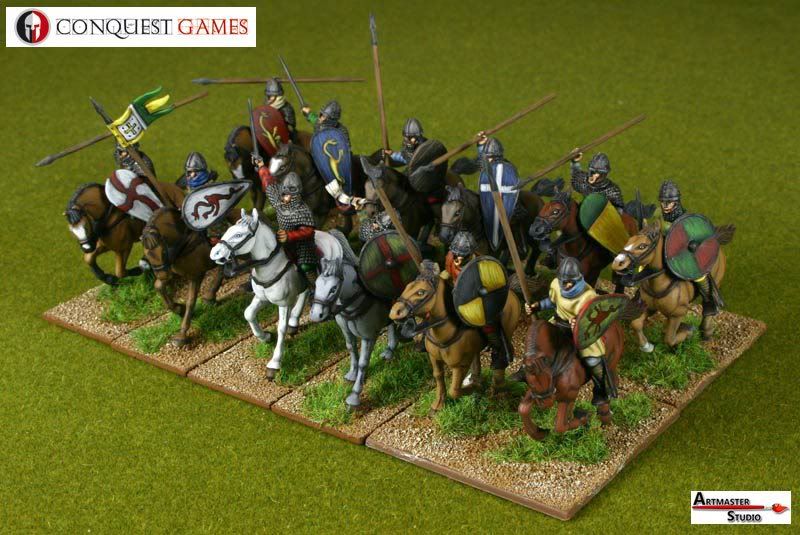
It took me a while to decide on the force but I was finally swayed by Conquest Games new line of plastic Norman knights.


Collecting a Norman army has the advantaged that it is a new period for me and therefore changing scale to 28mm will not conflict with my existing armies in my preferred 15mm scale. The new plastic range for the knights will save me a bit of money at a time of year when I am supposed to be spending it on other people (tis the season after all). And, they should be relatively quick to paint as the majority of them wear mail.

The army needs to be 300pts and will consist of 5 units of knights, one being the Duke, 2 units of Pueri, 4 units of spearmen, 2 units each of crossbowmen and archers. All in all in 2 months I need to paint 109 figures, 29 being cavalry, that's nearly two a day. Here's hoping for a quiet Christmas.

All the cavalry will be Conquest's plastic range. I am not a big fan of multi part plastic kits as I am not much of a modeller and don't like spending time assembling figures. That been said, I started on the first box of knights two nights ago and they we by far the easiest set of plastics I have assembled in recent years.

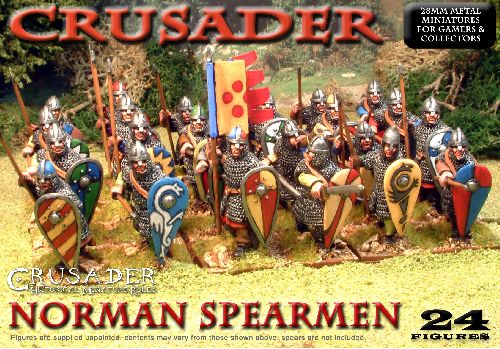
For the infantry I went with Crusader Miniatures over Gripping Beast based primarily on price as the quality between the two seems on par. They are ordered and I hope they arrive before I finish painting the knights.


Another advantage of the army is its potential to roll over another force, I hope. The last tournament I played in I used an Early Imperial Roman army and though a great army it relies on the Legions to cut their way through the enemy which takes time and casualties. This meant that although victorious in two out of three battles I did not pick up that many points towards winning the tournament.

The large amount of heavy cavalry in the Norman army should provide a greater punch and potentially roll over the top of the opponents. It is a change from recent tactics with Carthaginians where heavy reliance is based on the Numidian light cavalry so may take some getting used to.

Anyway, this diversionary project will hopefully only slow and not stop progress on the main projects.

Saturday, 13 November 2010

Sacking Syracuse

This week I managed to give my Carthaginians their first run out and they didn't disappoint. The battle was against Early Imperial Romans as part of the club's current ancient campaign. The battle was one of two simultaneous encounters for control of Sicily.

The armies deployed across the Sicilian plain with rough terrain and woods down the Carthaginian left. The Carthaginian's were on the attack and deployed their infantry opposite the Roman Legions who were intermingled with German mercenaries. Both armies had their cavalry far out on the Carthaginian right.


The Carthaginians opened the battle with a general advance headed by their elephants. The Romans countered by advancing their Auxiliaries to bring the elephants down. However the Numidian skirmishers got the better of their Romans counterparts and the Roman line began to fracture as the elephants charged home. The Germans allies were refusing to cooperate making it difficult for the Roman's to support the Auxiliaries.


On the right, the outnumbered Roman cavalry held their ground drawing on the advancing Carthaginian cavalry while some Roman Legions move against their flank. Spotting the manoeuvre some Numidian cavalry peel off to hold up the advancing Legions. This opens a gap and the Roman cavalry charges in an attempt to break through. The Carthaginian cavalry resist the charge while the remaining Numidian cavalry swarmed around the Roman cavalry putting them to flight.


On seeing the Roman cavalry in flight the Germans, unreliable throughout the battle, take flight leaving the Roman infantry outnumbered in the centre. The Legions launch a final charge into the Carthaginian line. However the Gods were not with them and bad luck turned worse with the capture of the Roman General routing the remainder of the army.

With the Romans in flight the Carthaginian army were free to move on and capture Syracuse. The news just gets better for Carthage as they have won the other encounter giving them full control of Sicily.


While the battle went to plan, I grouping the cavalry together on one flank in order to overrun it and surround the enemy, JP had such bad luck with the dice so the army wasn't really tested.

Grouping all the cavalry together on one flank should mean that on most occasion I will be able to take that flank, but it also means the other flank needs to be secured. If necessary that could probably be done with the elephants. They were effective in the centre but not devastating. Historically, it seems that while the Carthaginians preferred to place their elephants in front of their line a number of the Successors started placing elephants on their flanks to ward off enemy cavalry.

This would however weaken the centre where the multiple troops types were able to hit in succession, skirmishers followed by elephants followed by spanish and gallic light infantry followed by libyan heavy infantry. In the Carthaginian army list, only the Libyan troops troops count significantly towards towards the armies break points, so unlike most armies the Carthaginians can deploy in depth effectively. This maybe useful for refighting Zama where Hannibal deployed his army in three lines.

The 50 per cent command break limit again proved a potential weakness. The Roman cavalry consisted of two bases of light cavalry and two bases of heavy cavalry so by taking out one of each the whole command went.

All in all though I fully enjoyable game and a successful start to the campaign, i'm itching to get them back on the table.

Tuesday, 9 November 2010

Reflections on Impetus

Impetus is my favourite set of ancient and medieval wargames rules. I have been playing it now for over two years but it is only since I joined the Sheffield & Rotherham club nearly six months ago that I have been playing it on a regular basis. Prior to becoming hooked on Impetus I have played Warhammer Ancients, DBA, DBM, and Field of Glory. This blog will be about why I like Impetus, including highlighting some limitations.

I wish to start by saying what it is that makes Impetus the best set of ancient and medieval rules I've played. They are fun and produce a reasonable simulation of how I imagine an ancient battlefield. Like my favourite set of Napoleonic rules, Grande Armee, Impetus combines a units morale and fighting capability into a single value, it's VBU.


Impetus, as it's name suggests, is all about grabbing the initiative and maintaining momentum. The impact bonus units receive from charging encourages armies to press forward and the follow up combat mechanism can mean that a unit which begins to get pushed back and quickly be rolled over if it's opponent can follow up.

I like the look of the game, a unit looks like a body of men even when on it's own. The game mechanisms are simple and yet subtle. While it is possible to quickly march a large portion of your army across the battlefield, this is done at increasing risk of disordering the troops and the army being scattered piecemeal across the field. I like variability in the game and the initiative system in Impetus means that the order commands move in can vary each turn.

There are however a few issues with the rules that I think should be looked at and are potentially easily fixed. While I will spend more time discussing these in this blog I want to stress that the positives of Impetus monumentally outweigh these elements and it is my far the best set of rules for the period I have played.

Break point

In Impetus each unit has a VDU factor from 1 to 3 that represents the morale contribution that unit makes to the army as a whole. For example, a Legionary unit has a value of 3 whereas some skirmishers have a value of 1. A Command breaks at the end of the turn it loses 50 per cent of VDU, and an Army breaks at the end of the turn when it loses 50 per cent VDU.

The fixed break point of 50 per cent has two distorting impact so the game which I believe distort historical reality.

First, as each player is able to determine how close they and their opponent are to breaking, the result can be perverse behaviour as players chase individual units to knock the enemy over the break point rather than focus on the battle as a whole.

Secondly, it is beneficial to form an army into a single command as it has more staying power. An army in a single command must lose units up to 50 per cent of it's VBU in order to break. Dividing an army equally into two commands reduces it to a 25 per cent break point, as either half going would result in the whole command going. Though it does extend the command range making it easier to maintain order and manoeuver. Most armies were divided into multiple commands especially in the medieval period and the rules should encourage this.

The solution I propose is to have a system that starts to test whether an army breaks once it has past a certain threshold, for example 40 per cent. The test is based on the proportion of the army beyond that threshold and the length of the game. By not having a guaranteed break point players must focus on inflicting the most damage possible on the enemy at all times.

Strength of firing

There have been a number of situations where firing from skirmishers has almost overwhelmed heavy infantry but the new rules in Extra Impetus 3 may have resolved this.

Roman lines

As mentioned in my last post the exchange of Roman lines is to difficult, with only a 1 in 4 chance, and is limited to the Polybian period only between Hastati and Principes. I could go on for quite a while on this one and plan to do a future post drawing upon some current reading so for now I'll simply state that I believe that the exchange of lines needs to be easier and should be extended to late republican armies.


Scale

I want to finish this post with a quick comment on scale. I normally play the game in 15mm but recently participated in a 28mm tournament at Derby. The different scales do impact on how the game plays. The larger movement distances mean that there is often less opportunity to shoot though this is impart compensated for by larger shooting distances. 28mm certainly feels more hectic with less opportunity for initial manoeuvre.